



We are The Office for Feminist Love Letters. We write love letters for futures of solidarity. We write them for you. For us. We are in need of political love.
Our office celebrates feminist alternatives for exploitation and violence. Alternatives that were once, are made now or are imagined. Futures of solidarity. The office aims to create loving alternatives and is not here for biting critique. This is a writing practice, a network, a fungus, an improvisation and a collection of imaginations at once. It is about knowing our foremothers and taking care of children. The office works towards imagination, intellectual labor and praxis. It is lighthearted and dead serious at the same time. This is an office we can say ‘yes’ to.
An office. For love letters.
This is our first letter, a letter that I write for you (but we are a collective and others will write letters too). But I am not the first who does this: writing for political love. I stand on the shoulders of others, in line with others. A line that connects you and me to others that made space for love and life, that tried to make life possible. Others that wrote letters and books. Others that read letters and books.
Let’s begin with Toni Morrison. She writes in her essay ‘Peril’, that no despot is stupid enough to give writers free range. How to control writers is a question for most despots. But, she writes:
‘That is their peril.
Ours is of another sort.’
How liberating these words are. Instead of focusing our attention on what is a risk for despots, or on how despots aim for control, we can also simply decide not to, and start where we are. Because, actually, what do we find important? What do we need?
Yes, this is a good starting point. We live amid war enthusiasts, rising fascism and (aspiring) despots. The peril that a despot sees in writers sometimes means a direct threat to those writers. And to everyone else. This is ‘our peril’, Morrison writes: a world without art is sad, oppressive, deadly. Ultimately, making space for writers and artists is generosity towards ourselves.
Since we are speaking of generosity, about offering something to ourselves and to others, why not choose the form of the love letter? Is a love letter not the best form for generosity, the best form to allow ourselves something new? – A newsletter with political love, in your mailbox periodically.
The epistolary – the exchange of letters – is an intimate form. Diane di Prima wrote her most famous poems as letters: Revolutionary Letters. She began writing them in the 1960s. At first, she sent some to her school friend and poet Audre Lorde, but she also made them public, she published them: she sent them to an agency, an office, that distributed the letters to free newspapers and other outlets. The letters – the epistolary form – gave Di Prima the opportunity to write something that was both immediate and intimate, while publicly available. She speaks to you, personally – it is a letter. But she also writes about big questions and political themes and for anyone that is willing to listen. She whispers and growls, she yells, responds to political events, shakes us up and wants us to understand, finally: everything could change, be better. Everything should change.
We live in an era of endings. Right in the middle of a social order that produces death. Poisoned soil, PFAS in sea foam, rising sea levels, a genocide supported by our political leaders, massive public investments in weapon industries. Weapons manufacturers in competition: which tool can tear open bodies most efficiently?
Everything should change for life on earth. How can we think and make futures now? How can we live lovingly in the present? How can we, in Virgina Woolf’s famous words ‘think back through our mothers’ to do this?
I like reading texts that are an exchange. A conversation, or an exchange of letters. In many ways, all texts are exchanges, of course, even though authors put their names on their books as if they thought of everything all by themselves (me too). Books, like letters, can feel as though they were written just for you. We can feel very intimately related to written text. More than once, my own life was made possible, propped up, supported, changed by books. Some texts one perhaps prefers to keep for oneself, hold on to them a bit longer, re-read some bits, look through them again. Other texts we love to share. We may share a link, pass something on. This is how we share the love. The Office for Feminist Love Letters publishes for free, so pass it on!
Love is a force that makes change possible. Love is generative. Lauren Berlant said that love is one of the few places where people admit that they want to become different. Love cracks us open, making us unstable, tilting everything. Love is exciting, uncertain, destabilizing. There are no guaranties as to how we will change, how we will meet the future. All love is a risk. Love can remain unrequited, can be broken off, or be painful. But even more fundamentally: love changes us in unpredictable ways. We always exist in relation to others. When we relate differently, or with different people, we change too. Sometimes this is exactly what we need.
By writing and reading feminist love letters frequently and structurally we can permit ourselves to do something different (this is the love, says Berlant) and allow each other to make a different world possible. This is what we can call political love, says Jennifer Nash. When our Office speaks of love, it does not mean romantic engagements. Love is about wanting to make new worlds and lives possible. For Nash, standing in a tradition of radical Black feminists in the United States, it is crucial to make space for herself and other Black women. This love is necessary to be able to transcend the self and work towards another public culture. Without this love, without the life-giving that Black women perform for each other (who else will?), this is impossible. Love, for Nash, is an orientation towards the serious: transcending the self and living with difference.
Less stable selves and living with difference: yes. What we can learn from Nash is the importance of talking amongst ourselves while understanding that there is no simple ‘us’. This is where her perspective resonates with Toni Morrison’s. Our efforts here, our letters, are not oriented towards the state, towards employers or others in powerful positions. We do not ask for ‘inclusion’. We are just talking amongst ourselves. Because this is where everything begins.
Another reason for us to set up our Office is that we want to write in a way that does not necessarily fit so easily elsewhere. Poetically, lovingly, with humor and boldness. We want to write from our hearts: serious, agitating or warming. This is what we like to read, and it is what we hope can nourish you too. Of course, this often does not fit in our scholarly publications – the kinds of texts we write for our work, in offices that were not designed for love. And after years of publishing in other media (arts magazines, op-ed pages, current affairs magazines) we have plenty of experience with gatekeepers there. Sometimes they want accessibility to prevail over complexity. Sometimes they insist on showing ‘two sides’, or are adamant ‘devil’s advocates’.
A slogan on a wall in a building where I was: ‘Self publish, be happy.’
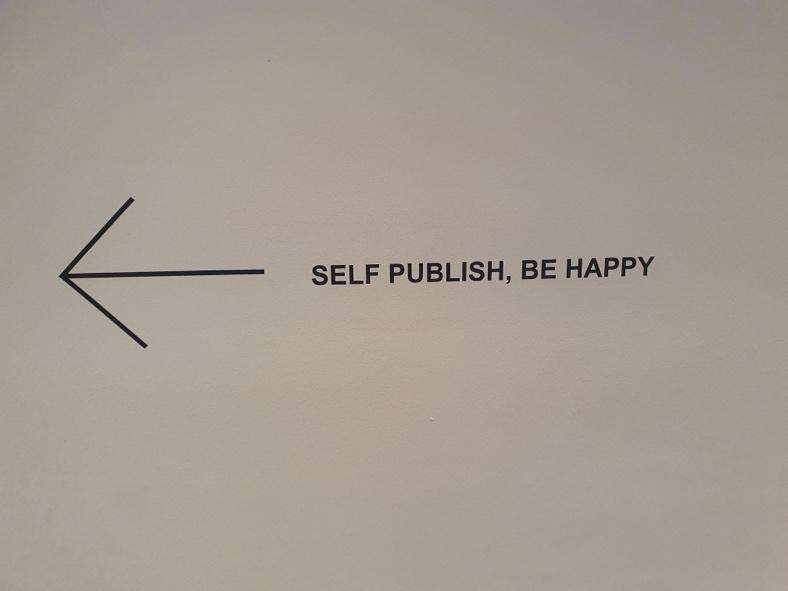
Yes! Of course!
We write these letters for love. For ourselves, too. Finding connections with our foremothers, writing from the heart, a collaborative process: it is good for us too, warming and life-giving in a time that is often exhausting, aggravating or depressing. Writing can be a nourishing practice, a form of care, for ourselves and for you. Reparative, perhaps. Rebellious, most certainly.
So let’s go back to Virgina Woolf once more. Because in an essay on reading, she called on us to have a mind of our own and be stubborn. She asks us to not listen to advice on what to read, how to read. To then offers her advice. She is not afraid of contradiction. Yes! We know that you have a stubborn mind of your own. That you want to learn, but you and no one else decides what you hear, what you use to think with. You are, in Woolf’s words, our ‘fellow worker’. Our ‘accomplice’. So do write us when you want to talk back.
What can you expect from us? The Office for Feminist Love Letters writes a love letter every season. Four times a year and a bonus in the Winter, when everyone can use a little more love and warmth. The letters will come from different writers and will engage different themes. Every newsletter will be a love letter. Some will celebrate foremothers, some alternative futures, some letters will show us which possibilities there are to live in this era of endings. You can find even more love on the website of the Office. Have a look!
The website for the Office for Feminist Love Letters was designed by Robin de Haan.
The minimalist design with the logo in the centre reminds us of an official document. Yet it does so in an idiocyncratic way, in bright purple. The transparency of the design of the texts and various parts of the site communicates the softer feel of a written letter.
In the typography, the same contrast can be seen by the use of the rounded Quando and the sharper Adelphe. Both were designed by female type designers. The latter is extra special, because it was designed with the intention to question gender in the French language.
A final ode to female typography is given by using the Friedländer font, designed by Laura Markert. The font is a re-design of the original that was made by Elisabeth Friedländer, one of the first women type designers, based in Germany. She designed the font for the magazine Die Dame, Germany’s first female magazine. Her font helped give this progressive publication its visual identity in the 1920s.
Not in any biological sense per se, but in the sense of taking care of next generations, creating possibilities for life.
Praxis refers, after Paolo Freire, to the reflection and action directed at the structures to be transformed. (in his book Pedagogy of the oppressed).
Toni Morrison, 2009: Peril. In: Burn this book, ed. Toni Morrison. Harper Studio.
Diane Di Prima. (2021). Revolutionary Letters. Silver Press.
Dit alles werk ik uitgebreid uit in mijn boek Kwetsbaar – Politieke mogelijkheden (Mazirel Pers, 2025).
Virgina Woolf, 1929: A room of one’s own.
They said this in conversation with Michael Hardt, published with this title: On the risk of a new relationality, 2012.
Jennifer Nash. (2011). Practicing Love: Black Feminism, Love-Politics, and Post-Intersectionality. Meridians, 11(2).
Ik maakte deze foto op een muur bij de bibliotheek van het Musee de la photographie europeenne in Parijs.
Virginia Woolf, 1932: How should one read a book? In: On Reading, Writing and Living with Books. London: The London Library, 2016.
Only by becoming disloyal to this world am I able to remain alive and human. Zakia Essanhaji wrote a love letter to those that try to remain alive, hopeful and human in a world that insists on death, destruction and dehumanization.
Feminists have had to confront sexual violence head-on. With courage and pugnacity, they politicised individual tragedies and turned them into a collective experience to be reckoned with. Massilia Ourabah expresses her feminist gratitude, and asks men: We did Me Too, how about Your Turn?
Noortje van Amsterdam paints the sky from her home. She is looking for crip solidarity: "My wish is for us (yes, together!) to reach for the sky in order to build networks where we can rehearse crip solidarity as a reformulation of our relationships with our workplaces, our own bodies, and those of others."
Feminists have written extensively about mothers and motherhood. But how do we relate critically and lovingly to our feminist (fore)mothers? Irene van Oorschot searches for answers in her deceased mother's library